Compressed Air Best Practices® Magazine interviewed Kurt Kondas (President), Steve Davis (VP Sales), and John Haslam (Branch Manager - Charlotte) from Universal Air & Gas Products Corporation.
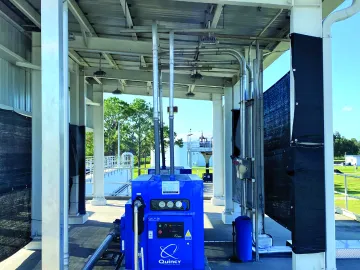
When a submarine docks for maintenance, the Navy requires a high-pressure, dockside, pier-power air compressor ready to be used in an explosion-proof environment. We have technicians working on military ships and submarines worldwide. For this, both UAPC and some of our technicians have been prequalified and have different secrecy clearances depending upon the project. In addition to our rental air compressors, we also have a fleet of CNG compressors available for long-term rent for the CNG refueling market.
By Kurt Sorschak (President and CEO) and Guy Couturier (Applications Manager) from Xebec Adsorption, Inc.
Compressed Natural Gas (CNG) is an alternative fuel source (to diesel and gasoline) with far-reaching benefits to North America. Strategically important benefits include energy independence, improved air quality, job creation, and lower and more stable fuel prices. This article discusses natural gas desiccant dryer requirements in Natural Gas Vehicle (NGV) refueling stations, compares deliquescent to desiccant dryers and reviews two on-site field gas upgrading examples in displacing diesel fuel.
Every municipality and utility is facing the reality of rising energy costs. In 2010, the Town of Billerica, MA, which is located 22 miles northwest of Boston with a population of just under 40,000 residents, engaged Process Energy Services and Woodard & Curran to conduct an energy evaluation of the Town’s Wastewater Treatment Facility (WWTF) and pump station systems sponsored by National Grid. The objective of the evaluation was to provide an overview of each facility system to determine how electrical energy and natural gas were being used at the facility and to identify and develop potential costsaving projects.
By Donald Miller, Vice President, Technical Services, Plastic Technologies, Inc.
Stretch blow molding equipment requires a significant amount of energy—both compressed air and electrical—to produce bottles. Creating an effective and efficient process, as well as monitoring and maintaining optimal process settings, can result in significant energy cost reduction. These efforts will also help produce containers that meet all of the required quality standards.
By Scott Minato, Marketing Manager – Air Preparation Products, and Barbara Pontisso, Filtration Products Specialist, Numatics, Inc.
In an ideal world, industrial air or gas supply lines would be free of particulate, water, oil and other contaminants. In the real world, however, supply lines typically deliver some contaminants along with the air or gas they were designed to carry. Left unchecked, these contaminants will cause efficiency losses, maintenance headaches and the premature failure of pneumatic components.
Compressed Air Best Practices® Magazine interviewed John MacKorrell (Extrusion Process Engineer, MGM Industries) and Dave Brittain, Steve Gilliam, and Wayne Kemp from Becker Pumps.
Two years ago, sales were picking up and we began operating six extrusion lines on most days. We had to bring in some portable chillers, to keep up, and we started looking at buying a larger cooling system. We wanted to get rid of the portable chillers and have room to grow into four more extrusion lines. The new system we looked at was a 100-ton system that would have cost us around \$150,000 in capital and installation and with a larger monthly electricity bill.
We were about to buy the new 100-ton chiller when our President, Abe Gaskins said, “Hold-on, can we replace the Liquid Ring pumps with something that doesn’t consume water”? That was our “Eureka!” moment.
This plastic extrusion factory spent an estimated \$180,711 annually on energy to operate the compressed air system at their Midwestern facility. Based on the air system operating 8,760 hours per year, the group of projects recommended below could reduce these energy costs by an estimated \$116,520 or 67% of current use. Estimated costs for completing the recommended projects total \$20,100. This figure represents a simple payback period of 2 months.
The right ingredients and processes are essential for manufacturing flavorful beverages that contribute to the company’s bottom line. But what happens to all those other “ingredients” that aren’t part of the recipe? Cleaning up those unwanted ingredients from bottling plant wastewater can consume large amounts energy, time and money—and become a distraction from the company’s primary goal of manufacturing beverages.
This meat processing and packaging factory spent an estimated \$203,640 annually on energy to operate the compressed air system at their Midwestern facility. Based on the air system operating 8,760 hours per year, the group of projects recommended below could reduce these energy costs by an estimated \$107,522 or 47% of current use. In addition, these projects will decrease compressor maintenance costs. Estimated costs for completing the recommended projects total \$21,900. This figure represents a simple payback period of 2 months.
By Josef Karbassi, Division Manager Automation, PIAB AB
Using suction cups and air-driven vacuum pumps is a preferable gripping and handling method of corrugated cardboard materials and boxes in carton-machines like case/carton erectors and rotary cartoners. Robot based applications, like palletizing and de-palletizing, are other examples where the best practice technology for gripping and handling is by suction cups and air-driven vacuum pumps.